
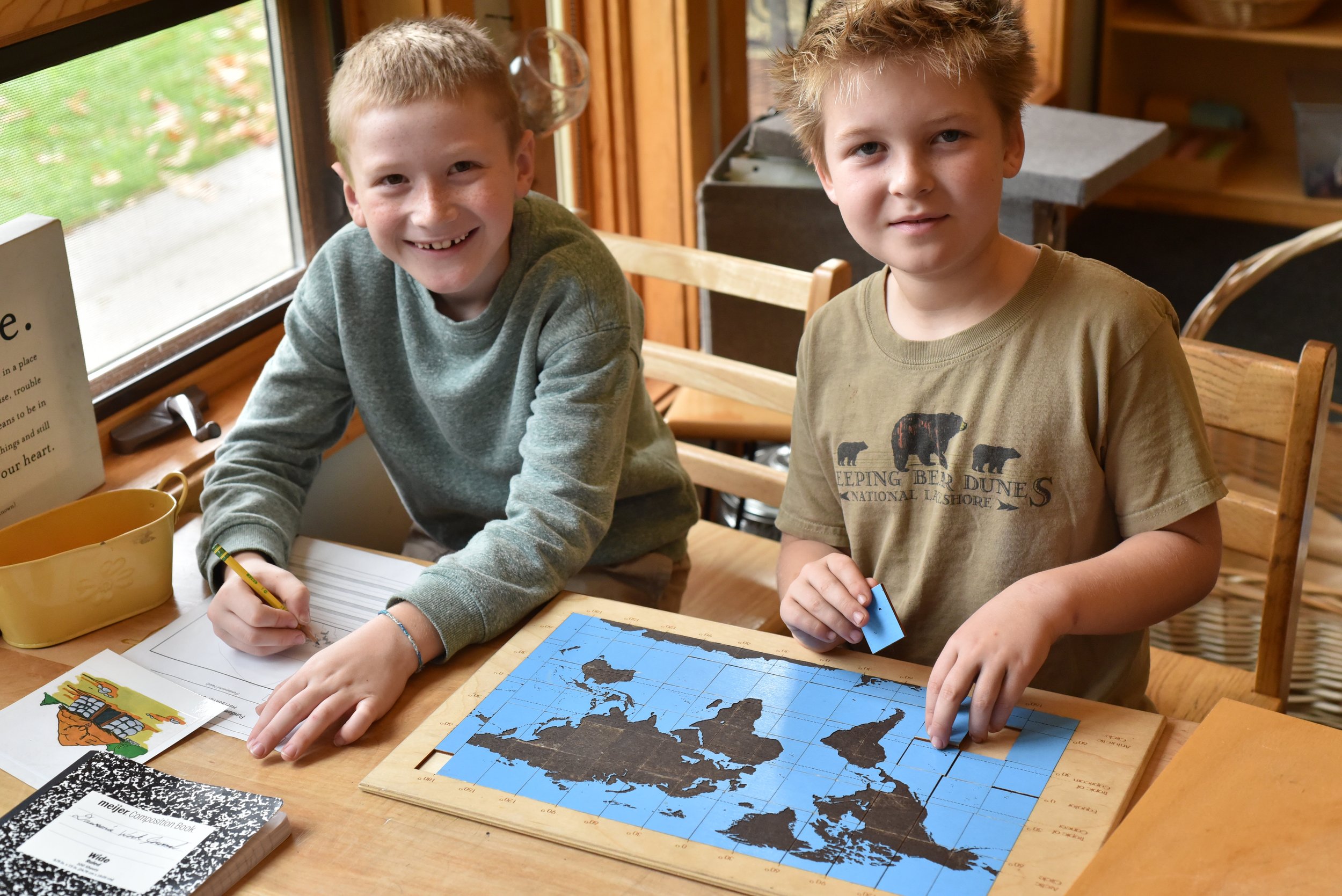
One day on a little walk…
Child: Mom, why do leaves change color in the fall?
Parent: As the days get shorter and cooler, trees stop making as much chlorophyll, the green pigment in their leaves. That allows the beautiful yellows, oranges, and reds to peek through.
Child: Why do they stop making it?
Parent: Because there's less sunlight, and the trees are getting ready for winter.
Child: Why do they need to get ready for winter?
Parent: They slow down and conserve energy until spring.
Child: Why?
Parent: (Smiling) Well, that's a rather big question for such a little walk!
Child: But WHY?
Parent: Because nature is full of amazing things, and everything seems to have a reason. Sometimes scientists spend their whole lives trying to figure out those reasons.
Child: Why do scientists want to know?
Parent: Because they're curious! Much like someone else I know.
Child: Mom, why are there holes in the dirt?
Parent: Probably worms or insects. Why don't we take a closer look?
Child: Why do worms live underground?
Parent: To stay moist and protected. Did you know worms breathe through their skin?
Child: WHAT? Why don't they have noses?
Parent: (Taking a deep breath) You know, I thought we were just going for a walk!
Child: But Mom, why—
Parent: (Laughing) Never mind. Keep asking. I think we might be learning something today!
Somewhere along the elementary years, children's questions seem to multiply. Their curiosity stretches beyond simply wanting to know “what” something is to understanding “why” it happens, “how” it works, and what would happen if something were different. But why do they crave “Why?” What makes that “why” the dominant question of our conversations during the elementary years?
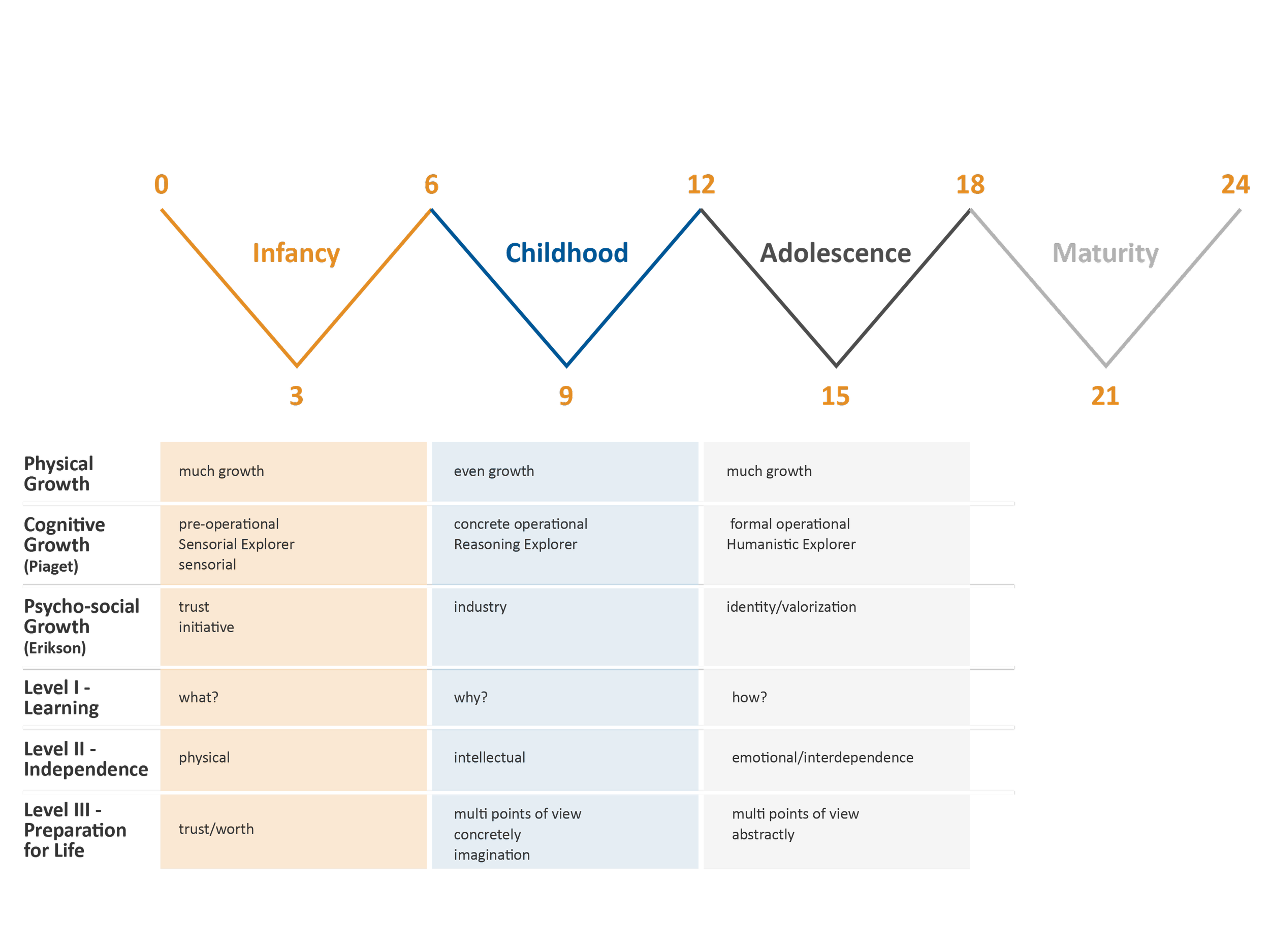
We know from Dr. Montessori’s observations that children develop in planes.
In a manuscript written by Montessori about [the development of the child], she says that scientific studies and meticulous testing carried out in all parts of the world, with children of different races and different socioeconomic conditions, have shown scientists that development does not proceed in a linear or constant fashion. On the contrary, it proceeds or occurs in periods or cycles or planes, such as we see represented here in her drawing. (Grazzini)
These planes occur in six-year spans with sub-planes lasting three years. Children display characteristics that exemplify each sub-plane. Some of these were observed first by Dr. Montessori and some were detailed by other educational theorists, such as Piaget and Erikson.
Below is a chart that enumerates some of the growth and development for each plane. If we look closely at development Level I – Learning, we see that each plane has a focus question. In the first plane, the focus question is “What?” as the child is learning about the objects in the world around them. In the second plane, the focus question is “Why?” Their minds are busy making connections, testing ideas, challenging explanations, and trying to make sense of an increasingly fascinating world. By the third plane, the adolescent focuses more on “How” things work in the world.
Now, this doesn’t mean children in each of these planes only say that one question! It just means that the question listed drives a lot of their learning. When we look more closely at the elementary years, we can divide this plane into “The Cultural Explorer” (6 - 9yrs) and “The Collaborator” (9 - 12yrs) sub-planes.
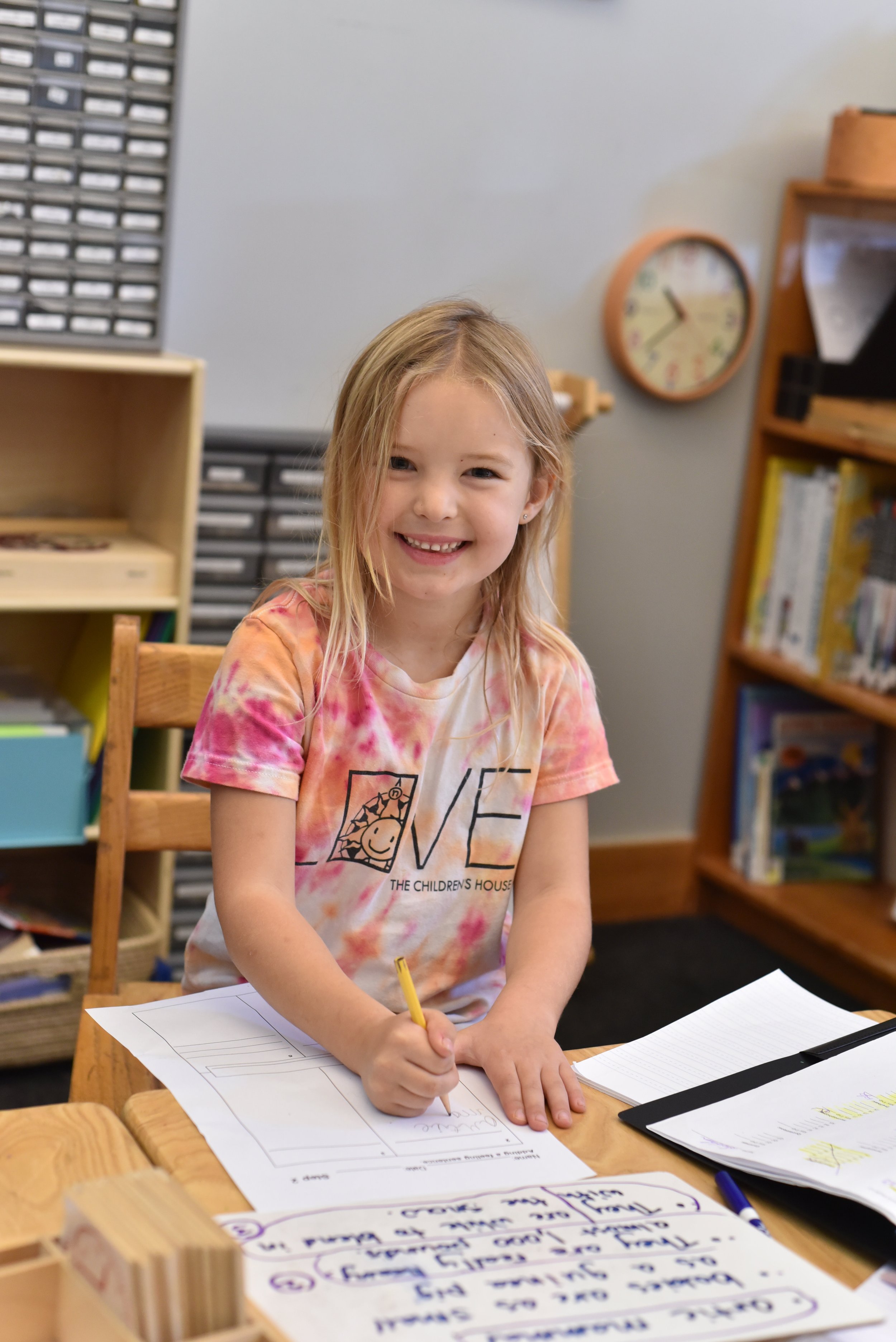
“The Cultural Explorer” craves the “why” because of some of their characteristics:
They are moving from a concrete understanding of things to understanding them abstractly. Understanding the “why” helps them keep the examples in their head.
They have better communication skills and therefore their intelligence can be reached directly. Like the first plane, they are able to take on a lot of information. They thirst for knowledge.
Moral awakening - developing a moral sense – sensitivity to culture - social relationships – Age of Justice – “That’s not fair”. Understanding fairness and justice leads to lots of “why” questions.
Imagination is strong – can imagine what exists outside his/her environment. Detailed knowledge of reality is what feeds imagination. So, more understanding of “why” leads to more creativity.
Continues to improve his/her coordination – energetic. Lots of energy for lots of learning!
Becomes more independent and disciplined. They want to assemble their own set of knowledge.
Moves in ”herds”. Interaction leads to an exposure to different unique individuals. “Why” doesn’t everyone see the world the way I do?
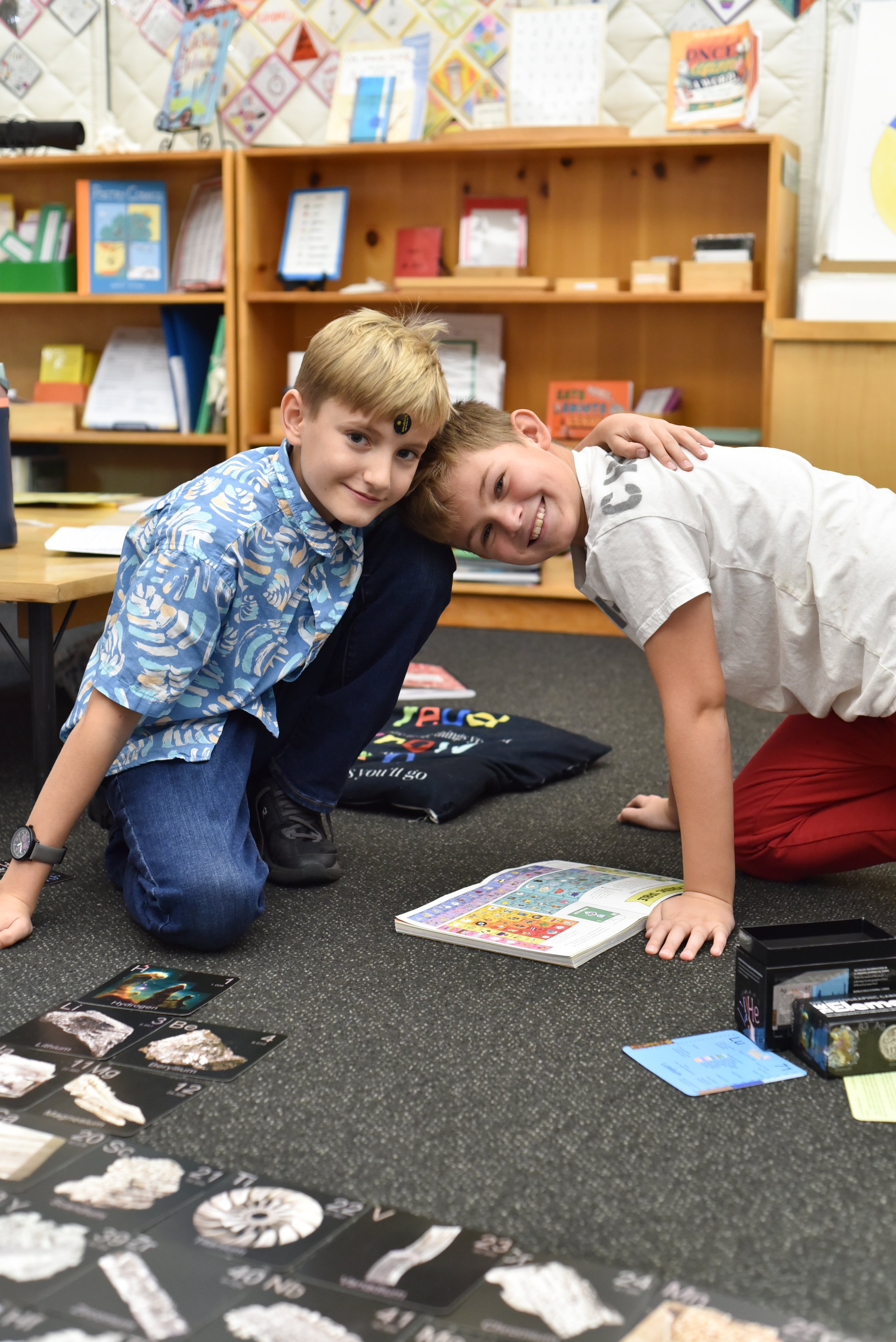
“The Collaborator” has other characteristics that lead to the “why:”
Interested in cause and effect. “Why” did that happen?
Begins to consolidate and assimilate all that was learned in the last sub-plane. Still building their own set of knowledge. They start to find inconsistencies, which lead to “why.”
Child becomes more logical and rational. Finding the “why” helps put the logic in perspective.
Child becomes more social, collaborative, has a cosmic perspective: wanting to know more about the universe. This is a more advanced and complex understanding of other people and their perceptions. There are also deeper questions of the “why” of existence.
Connects information and inter-relate the disciplines, no longer places things in separate academic silos. “Why” don’t people see these connections or try these solutions?
Steady physical growth, rude, impatient, less loving, has a compulsion to understand the outside world. “Why” don’t you see things my way, since clearly I’m right?
It is clear that during the Childhood plane, the children are physically becoming bigger, and they are also ready for bigger questions. The characteristics found in their development lead them to crave the “why” question.
Elementary children will definitely ask a lot of questions. It is important to remember that as adults in their lives, we get to facilitate their learning. We may give them some answers. We will serve them even better when we let them discover the answers for themselves. When they see that they can find the answers, they are building their intellectual independence. That is another level of development! While the endless stream of questions can sometimes test even the most patient adult, it is worth remembering that these questions are not interruptions to learning. They are the learning.
Grazzini, C. (1996). The four planes of development. NAMTA Journal, 21(2), 208–241.
